How It Works
This page explains what Quratic does under the hood, framed for agencies who need to explain the methodology to clients.
What Quratic measures
Section titled “What Quratic measures”When a potential customer opens ChatGPT, Perplexity, or Gemini and types a question like “what is the best accounting software for SMEs in Singapore?”, the AI writes a free-form response. That response may or may not mention your client’s brand.
Traditional SEO tools cannot measure this. Quratic does.
The collection process
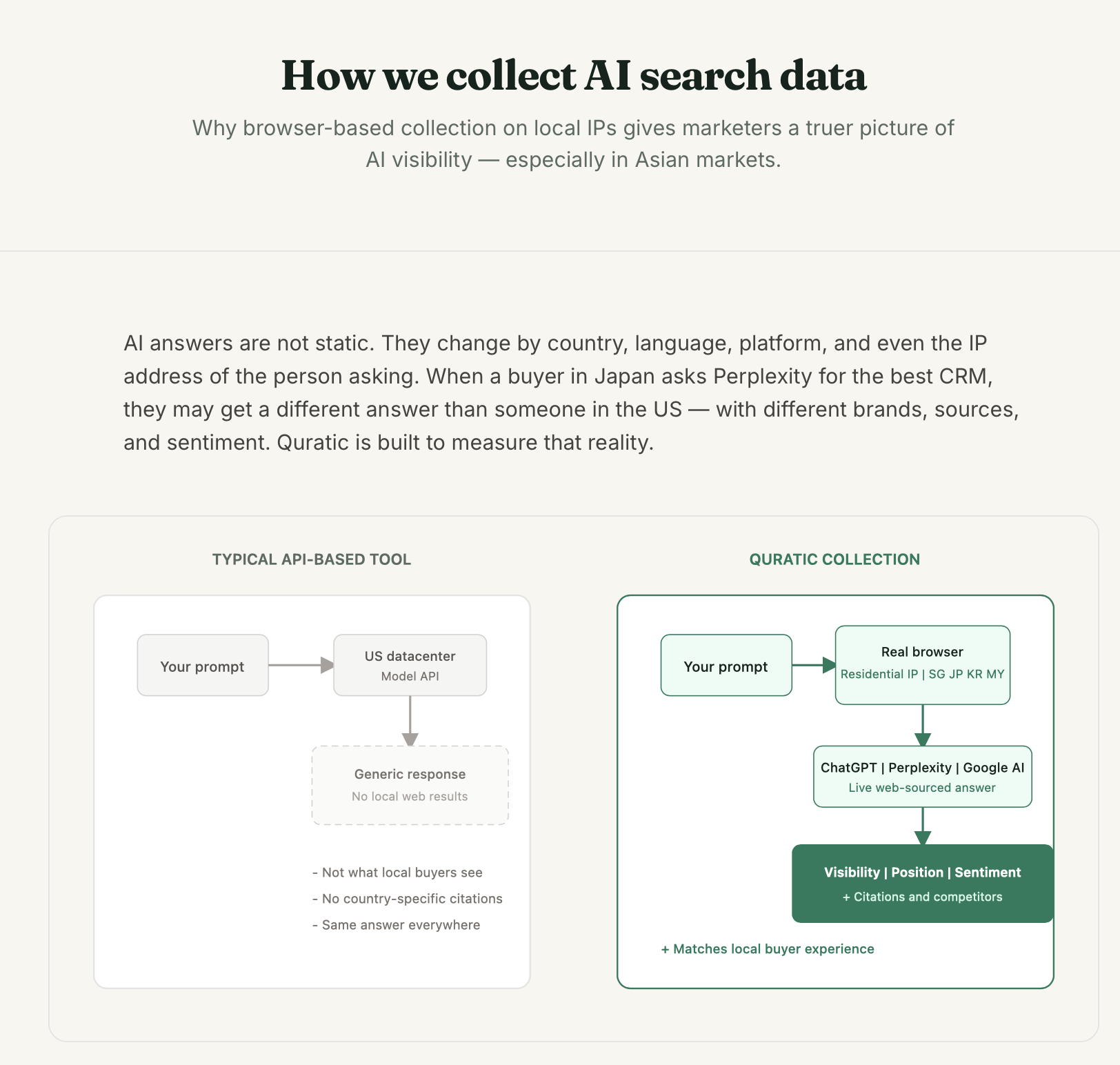
Section titled “The collection process”For each prompt in a client’s project, Quratic:
- Opens a real Chromium browser session
- Routes traffic through a residential IP in the client’s target country
- Submits the prompt to each active AI platform
- Waits for the full response
- Records the complete response text and any links
- Detects the client’s brand name and all competitor names
- Stores the result and updates the dashboard
Why real browsers matter
Section titled “Why real browsers matter”Quratic uses real browser sessions, not API calls where possible. This is important because:
- AI platforms localise responses based on the request’s IP location — a Singaporean residential IP gets Singapore-relevant results
- The data reflects what actual end users see, including any A/B tests, interface variations, or web-browsing-enabled responses
- No API result is sanitised or differently formatted from the user-facing experience
When explaining the methodology to a client, you can say: “We simulate what a real customer in Singapore would see if they asked this question on ChatGPT today.”
Metrics Quratic tracks
Section titled “Metrics Quratic tracks”For each client brand and every check:
| Metric | What it measures |
|---|---|
| Visibility rate / Share of voice | % of checks where the brand appeared |
| Position | Where in the response the brand appeared (1 = first mention) |
| Sentiment | Whether the AI’s language about the brand was positive, neutral, or negative |
| Citation | Whether the AI linked to the brand’s domain as a source |
Data variability
Section titled “Data variability”AI responses are non-deterministic — the same question can get a different answer on each run. This is normal. Quratic mitigates this by:
- Running checks on a consistent schedule (weekly, every 48h, or daily)
- Accumulating multiple data points per prompt
- Reporting share of voice as a percentage over time, not a single binary answer
The result is a statistically meaningful trend, not a one-off snapshot.